

“I’m mad keen on recycling because I’m worried about the next generation and where all this waste we’re producing is going. It has to stop. I wash out my plastic containers and recycle envelopes, everything I possibly can.”
— Cherie Lunghi, British actress
Today, as we become more aware and vocal about the climate crisis, our lifestyles and how we consume, creators, designers, thought leaders, and architects across the world are recycling everything they can. As artists, they’re looking at trash with a new pair of eyes. “Can we upcycle or turn this into something functional?” — this outlook inspires and informs how the world approaches sustainability. The words “one man’s trash is another man’s treasure” haven’t been truer!
WorkshopQ is one such Indian organisation that works with discarded items. It is an environmental-conscious design company founded by Radhika Mittal and Madhvi Pittie. Designers, artists, and animal welfare activists themselves — this sister duo upcycles and repurposes trash into art installations and artefacts. Known for crafting innovative products, they have empowered over 70 artisans. We caught up with Radhika and Madhvi to know more about WorkshopQ and what sustainability means to them.
How would you describe what WorkshopQ does and what inspired you to start it?
WorkshopQ is a green design studio that uses the power of aesthetical sustainability to transform India’s mounting industrial waste into meaningful resources such as art installations, sculptures, and home décor products. Our initiative focuses on reducing waste from our planet through employing innovative methods to upcycle pre-and post-industrial and consumer waste. We employ a zero-waste policy to upcycle every bit of waste, even those generated by us.
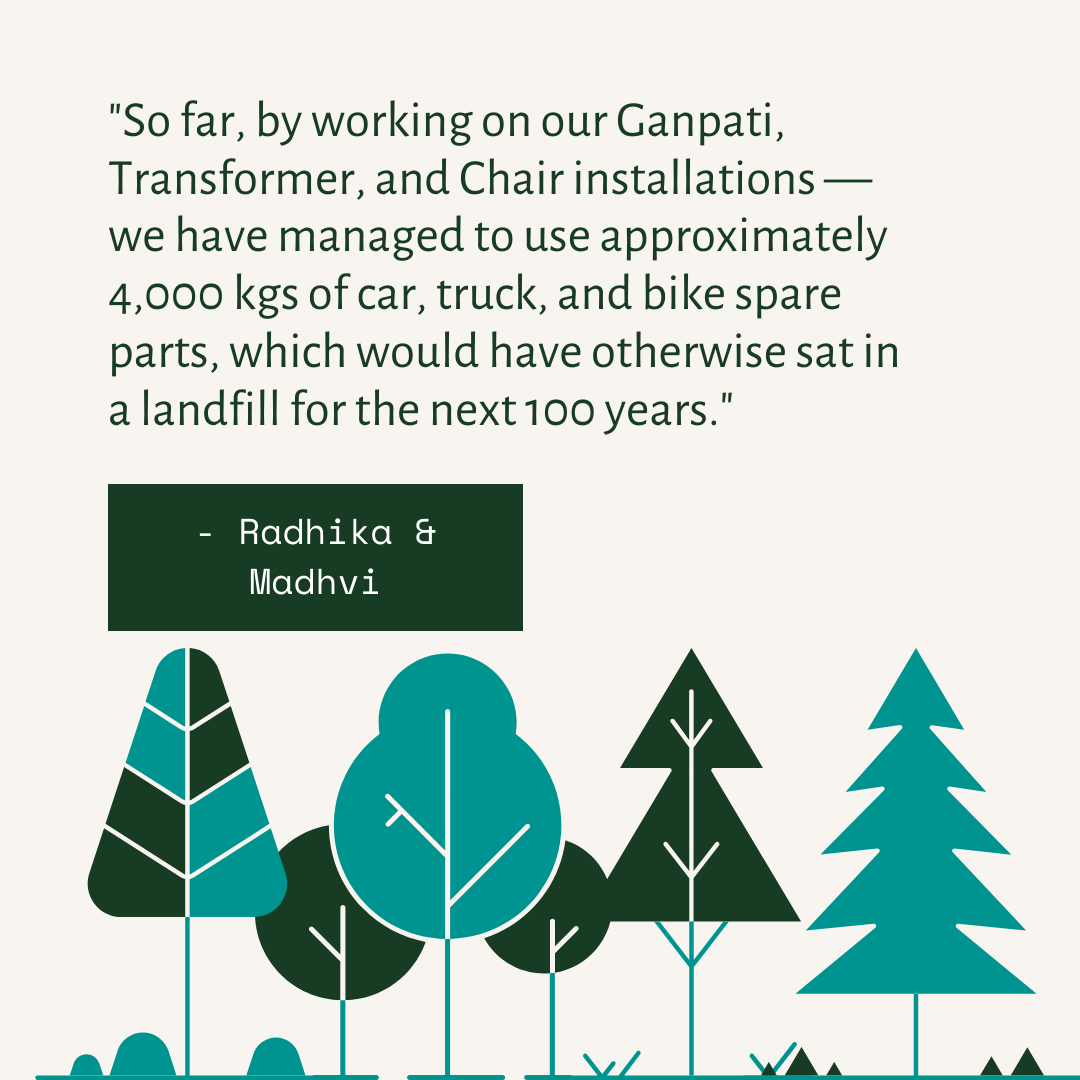
For an installation we made for Bisleri in association with the Mumbai Marathon, we upcycled another 5,000 waste plastic bottles. WorkshopQ has successfully upcycled tons of waste vinyl records, scrap wood, small metal objects like keys and other general household and factory waste over the last six years. Since our base is in Mumbai now, we can proudly say that we have certainly helped create an impact to upcycle, reuse and recycle as much as we can by spreading awareness through our art.
We also actively work with corporates to help them streamline their waste management by creating upcycled products from the waste generated at their factory premises. Many companies are adopting the EPR policy (Extended Producer’s Responsibility), which enables them to manage the pre/post-consumer waste, promote employee engagement and support their recycling goals.
Q. What is your approach to design, and what role does sustainability play in it?
Through our innovations, we prove that upcycling is not limited to only earthy-looking colours in small objects; it can also mean endless possibilities to reimagine and reuse. Over the years, we have evolved from creating home décor products to large-scale art installations and sculptures to spread awareness and provide more permanent solutions for upcycling. Hence, armed with a strategy to spread ‘Awareness through Art’ — we target public spaces and events to showcase art installations made from industrial waste. Finding a definitive creative voice has brought about a turnaround in our studio processes, which now define art through sustainability. Our studio looks at fresh approaches to fuse green design and innovation to smooth out the creases between ‘green’ and ‘design’. Our installations are in sync with our USP, ensuring that the ‘scrap’ and ‘waste’ are not instantly recognisable.
Finding a definitive creative voice has brought about a turnaround in our studio processes, which now define art through sustainability. Our studio looks at fresh approaches to fuse green design and innovation to smooth out the creases between ‘green’ and ‘design’.
Q. Can you take us through your creative and development process?
Sourcing the raw material is not really a defined process. Sometimes we design the product first and then try to use different waste materials that fit in that design. Many a time, a trip to a raddiwala or scrap yard can work wonders.

We treat the waste material in different ways to check its usability and how we can enhance it aesthetically.

Upcycled Plastic Paithani frames
For several projects, we were briefed to create art installations or sculptures for a company’s milestone year or a product launch wherein the art piece resonates with their company ethos. We worked backwards by first designing the sculpture and then fitting the waste metal parts like a 3D jigsaw puzzle. We developed prototypes on a 3D printer and subsequently we sourced the required material and worked with skilled artisans to deliver a defined shape to the waste being repurposed. Our USP lies in scrupulously designing our art to not look like evidently processed waste.
Q. What’s your favourite or most fulfilling art installation or collaboration so far? Can you tell us what went into its making?
Starting a business as a fresh college graduate at the age of 23 was a daunting decision, and every day of work was a learning experience from our karigars, workmen, and clients. When some clients saw the two of us (my sister and I) walk into their office, they were surprised to see how young we were and took us under their mentoring wing, which was the most rewarding experience of our entrepreneurial journey. In April 2019, we were approached by the Jaya He GVK Museum (the art curation team at the Mumbai International Airport) to create an upcycled artwork inspired by Maharashtra for their “Celebrate Maharashtra” festival. As designers, upcyclers, and eco-warriors, we wanted to create an artwork that was simply more than just re-creating an iconic Maharashtra symbol by a creative assemblage of waste. An experiment of waste plastic bags and candy wrappers used as the weft and cotton thread as the warp in a handloom yielded a stunning glistening fabric. Having our art displayed at the Mumbai Airport filled us with pride and a sense of fulfilment. It was indeed a dream come true.
Q. How have you seen the ecosystem of the market, consumers and corporates, and their appreciation of upcycling, evolve over the last few years?
The latest UN projections predict the world population to be around 8.5 billion in 2030 and 9.7 billion by 2050. The need of the hour, therefore, is sustainable consumption and production. By efficiently using resources and looking at economic growth from an environmental perspective — WorkshopQ is redefining the sustainable narrative, where it is no longer a term but an experience that the end consumer acts on and reminisces. We have managed to support above 70 artisans in our eight-year journey. With individuals becoming increasingly aware and companies adopting sustainability as their business ethos, sustainability is already an experience.

Upcycled Ganpati Idols
Q. WorkshopQ is clearly a purpose-driven brand. How do you see its impact on the lives of the artisans you work with?
We want WorkshopQ to be a movement the whole country can join through localising and helping artisans. Indian culture is fragmented into so many different forms of sustainability, which shine through its various craft forms. We want to revive these crafts by giving them a modern spin and preserving their eco-friendly nature through our public art installations. Having helped companies such as Raymonds, Bisleri, Ford, Ashok Leyland, Indian Oil Corporation, GVK, etc., by upcycling their waste into art installations and smaller products — WorkshopQ has completed over 60 projects along with supporting the artisan community of India.
Q. What have been some of your challenges as an entrepreneur?
Most of our clientele are corporates whose Marketing & HR departments are spearheaded by men. The most common problem that we face is the “need” for us to work. We have been repeatedly questioned on why we, as married women, need to work. This patriarchal mindset of women being financially supported by their fathers and husbands, which does not require them to work, feels smothering and demeaning. We know we are the best in what we do, and we work to feel empowered. We are grateful to have parents and husbands who support us every step of our way and share family responsibilities. Teaching our children the importance of following their passion is the only way to change this deep-seated mindset.

Q. What does the future look like for WorkshopQ?
We have a team of skilled craftsmen, designers, and fabricators who meticulously handcraft every product and art. The pandemic has been complex for us — but with more and more people and companies adopting sustainability as their business ethos, we see incredible potential in the market. As we move towards a more direct-to-customer model and establish a B2B segment of smaller products and grow our installations, we intend to scale up and segue into e-commerce. As a D2C vertical of our business, we also aim to make smaller art pieces, sculptures, and products and retail them through e-commerce. We intend to grow our art installation part of the business by collaborating with the civic bodies of each city. We want to market our products correctly, list them at the right places, innovate at every junction, and explore new avenues and materials to upcycle and fuse them into public art to make our urban landscape beautiful and sustainable.


